

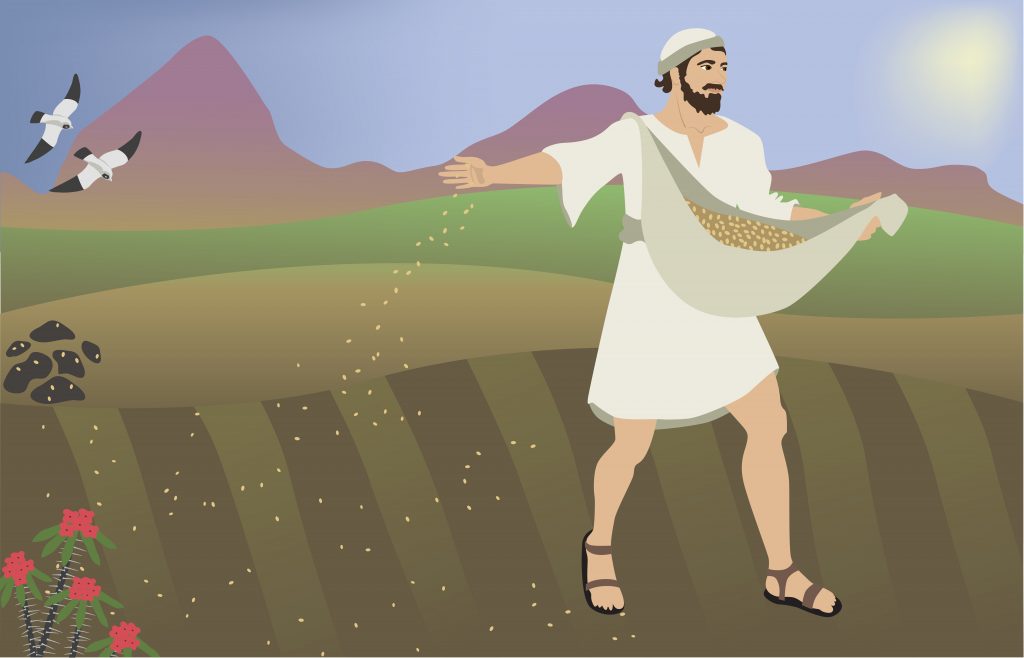
As I was reflecting on this parable, the country was in the grip of a heatwave, and it gave me a certain amount of sympathy for the seed that fell on the rocky ground — was burnt up by the sun and withered away.
And I must say there are times during these wretched heat waves we keep getting when I feel quite withered myself.
But as I mulled the parable over more in my mind, I began to see the heatwave differently, and I realised that Jesus was offering his disciples a timeless truth. I realised that the path for all of us is full of distractions — whatever shape or form they take.
Be it from not having time to draw closer to Jesus, being hardened by the difficulties of life, or allowing superficial matters to dominate our minds — such as summer heatwaves.
Jesus was teaching that the one who becomes aware of what crowds, hardens, or drains the heart is the one who can grow — not only practically, but more importantly spiritually.
A Sower went out to Sow…
The seed represents the word of God, while the soil represents the condition of a person’s heart. The sower scatters the seeds everywhere — not cautiously, not sparingly, but generously. He scatters them freely, letting them fall wherever they will.
This is an analogy of the word of God being spread far and wide; offered freely and hopefully to all, and as the seeds fall from the Sower’s fingers, Jesus reveals four traits of the human heart.
It’s useful to appreciate at this point (wherever we are in our journey of faith) that we all have elements of the traits Jesus describes — of both good, bad, and indifferent. There is no one kind of person who is perfect.
The Stony Path — the Unreceptive Heart
Some seeds fell on the hard path, where they could not sink in. Birds swept down and carried them away before anything could begin to germinate.
Today this might be the distracted commuter, the overwhelmed parent, the endlessly scrolling teenager — people who genuinely hear God’s word but have no inner space for it.
They are not hostile; simply hurried. Their attention is elsewhere, their hearts preoccupied. The seed never settles long enough to begin its quiet work under the guidance of God’s transforming power.
This is not a stage of faith but refers to availability — something any of us can be short of when life becomes too much.
The Rocky Ground — the Shallow Heart
Other seeds landed where the soil was thin. They sprung up quickly, full of promise, but withered under the heat because they had no depth. No roots.
Today this is the person who receives God’s word with real joy — moved by a moment of hope and renewal — yet whose faith has not grown the deep roots needed to endure pressure. When life becomes demanding, early enthusiasm often collapses under the strain.
This is not necessarily a “new believer”; it is the human tendency to respond emotionally but not deeply — something that can happen at any point in the Christian journey.
The Thorny Soil — the Crowded Heart
Some seeds grew among the thorns. They survived, even looked healthy, but never bore fruit because other things in their life took over.
This is the overcommitted professional, the anxious worrier, the comfort seeker, the busy parent — people whose faith is genuine but constantly squeezed by competing priorities.
The life of faith is present, but it is slowly suffocated by demands, distractions, and comforts that multiply until there is no room left for God’s word to flourish.
This is not immaturity in the faith, it is simply overcrowding — a condition that can come upon any believer when other interests become dominant.
The Good Soil — reveals the receptive heart
Some seeds fell into good soil. They sunk in, took root, and grew steadily until they bore fruit — thirty, sixty, even a hundredfold.
This is the open, attentive heart: the person who makes room for God’s word, lets it travel deeply within, and stays with it long enough for it to shape their choices, habits, and hopes.
They are not perfect; they are simply willing. They listen with humility, persevere through difficulty, and allow God’s truth to reorder their priorities.
In this soil, the word does what it was always meant to do — it grows into a life that enriches others, a character that reflects Christ, and a harvest that multiplies far beyond the seed that was first sown.
Bringing it Together
We probably all carry some of these traits, or perhaps even all of them.
We all carry, to some degree, places that are hard, shallow or crowded. But also, places — thank God — that are good soil.
So the invitation of the parable is not to judge others, or berate ourselves for our shortcomings, but rather to allow Christ’s teachings to cultivate our inner journey.
Allow ourselves to be formed into the likeness of Christ —and the person God created us to become.
Because, even today, the Sower is still sowing. The seed is still falling. And the harvest is yet to be reaped.
Lord, Make My Heart Good Soil
As we come to the end of this parable, Jesus does something quietly profound. He doesn’t ask us to decide which type of soil we are.
He invites us to consider which type of soil we are becoming.
Because over time hearts can change. Paths can be softened. Rocky places can be cleared. Thorns can be cut back. And good soil can be tended.
The Sower is still scattering his seed today. He is not looking for perfect soil, but willing soil. Not a finished field, but land under cultivation. Work in progress. Personal formation.
With this in mind, I found myself looking more closely at the heatwave we were living through.
And even though I have genuine issues with intense heat, I told myself, to get a grip, and resolved to adopt a more faithful and practical perspective, leaving the long‑awaited cool change in God’s hands as I put my heart and mind into preparing this sermon.
And as I took this approach, I began to realise this was what Jesus was teaching about:
And that I had – unwittingly – landed myself in the thorny soil and was allowing a temporary weather condition to completely rule my life.
I realised then that I could overcome my trepidation of the heat situation, and that we are never too old to be further shaped by Christ’s teachings, even when the conditions feel harsh.
And this is the central message of this parable;
That, when we allow him to, God is always ready to work within us, shaping us into the soil where His life can develop and flourish.
Visit A Church Near You and learn more about Jesus from other Christians;

One Response
Thanks again Mary